
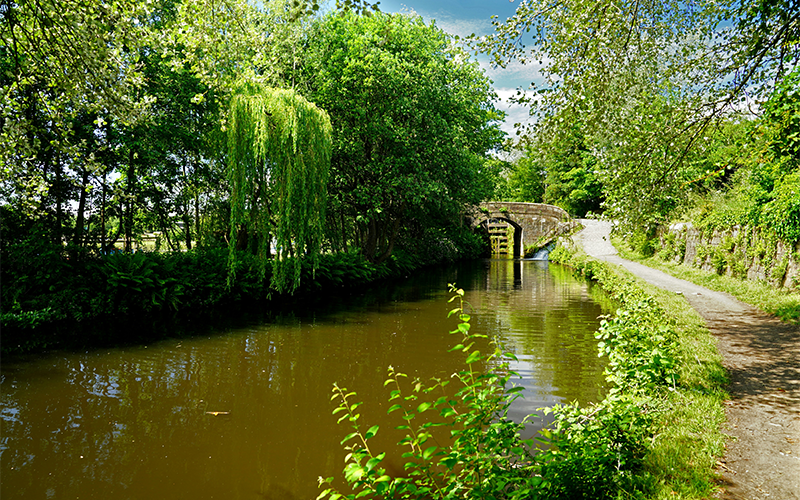
Water ways: latest government white paper brings a flood of landscaping opportunity
From climate-driven floods and droughts to sewage pollution in our rivers, water has become a hot topic in landscaping and beyond, so much so that the government launched a major review after coming to power in 2024. Led by the Independent Water Commission, the review of the water sector in England and Wales concluded in summer 2025, producing a number of recommendations for reform. The government has now responded to these recommendations by publishing a white paper – the first stage of the law-making process – and here we will explore some of its key proposals. But first, let us take a look at the current state of the water environment and the role of landscaping in addressing water-related issues.
Flooding, drought, and water quality
Water issues are often described as a result of having too much (flooding), too little (drought), or too poor (water quality), with the first two being quite closely connected and the third slightly less so. That said, when it comes to public policy, each issue tends to be addressed in isolation; the government has distinct teams and plans for flooding, drought, and water quality. From experience, many inside and outside of government are keen to take a more joined-up approach to water issues, but this is challenging due to the range of sectors involved. Nevertheless, the reality is that stakeholders like the landscaping industry experience all three water issues and can even help address all three through a single project.
Let us take flooding and drought, for instance, which are both to do with the amount of water present at a certain point in time. As climate change advances, rainfall patterns are becoming more intense and less predictable, meaning water can build up and deplete more quickly. On a macro scale, the risk of flooding and drought can be mitigated through major landscape changes and new reservoirs, but these interventions often require government coordination and significant funding. However, smaller scale measures, such as permeable paving and soakaways, can also make a significant difference when combined and they are easily implemented by landscapers and their clients.
Water quality in our rivers, lakes, and aquifers is largely determined by water companies and farmers, but pollution from urban areas and roads also has a major impact. Despite the recent political focus on sewage in rivers, the quality of our waters has generally improved over the last few decades. Nevertheless, further improvements are needed and the landscaping sector can play a role, both in terms of reducing inputs and managing water. For instance, many grounds maintenance companies are reducing the risk of pesticides getting into water by taking a more integrated approach towards pest management. And some of the measures for managing excess water, such as soakaways, ponds, and swales, are also very effective at filtering pollutants out of water.
Water sector review
Heightened public concern over sewage pollution in rivers led the current government to come out swinging when elected in 2024. Then Environment secretary, Steve Reed, quickly announced a range of measures to address the problem, almost entirely aimed at water companies. These measures included a mix of short- and long-term actions, including ringfencing funding for water infrastructure, new criminal charges for failing executives, and a wide-ranging review of water sector regulation in England and Wales. The last of these was conducted by the newly established Independent Water Commission and produced recommendations for reform in 2025. Having considered these recommendations, the government has now published a white paper on changing water sector regulation, titled A New Vision for Water.
As you might expect, much of the white paper is focused on water companies, but some of the key plans do touch on other sectors such as landscaping. With nationalisation off the table, the most significant proposals for the water industry include longer-term, more-wide ranging direction from government, moving to a new single water regulator, and various new measures to attract investment. In addition, the paper talks about an enhanced regional water planning system, a shift towards pre-pipe solutions for water management, and removing barriers to using more nature-based solutions – in all of which BALI and its members can play a role.
An enhanced regional water planning system, for example, will bring water companies together with sectors like agriculture, transport, and development to improve the water environment and supply planning. This activity could provide an opportunity for landscaping representatives and major businesses to take a strategic role in addressing water issues, potentially unlocking further opportunities for work in the region. Elsewhere, a move towards pre-pipe solutions for water management, such as rainwater harvesting and sustainable drainage solutions, and nature-based solutions for pollution reduction could open up for opportunities for landscapers in a more direct way.
While these proposals may feel somewhat abstract or remote, they are likely to reflect a broad direction of travel in the water sector over the coming years and may be used as a guide. Like all policy documents, the white paper is merely an indication of current government thinking and specific ideas may be dropped, altered, or replaced in the future. However, it is also true to say that moves towards greater stakeholder collaboration and more pre-pipe and nature-based solutions build on existing trends and will probably come to pass. And, therefore, landscapers may wish to take the proposals into account when making long-term business decisions, particularly where existing activity is closely tied to water.
Looking ahead
A New Vision for Water is the product of both an extensive review of the water sector, as well as the political furore which preceded it, and is, therefore, an ambitious document. This fact is recognised in the white paper itself and will be addressed by the UK and Welsh governments through a shared transition plan. The transition plan will be published this year alongside interim guidance for regulators on how to navigate the change. Meanwhile, the policy team at BALI will continue to monitor developments, including the eventual new water bill, influence relevant parts where possible, and communicate potential opportunities to members.
This article originally appeared in the Spring edition of BALI's Landscape News
https://www.bali.org.uk/news/landscape-news/