
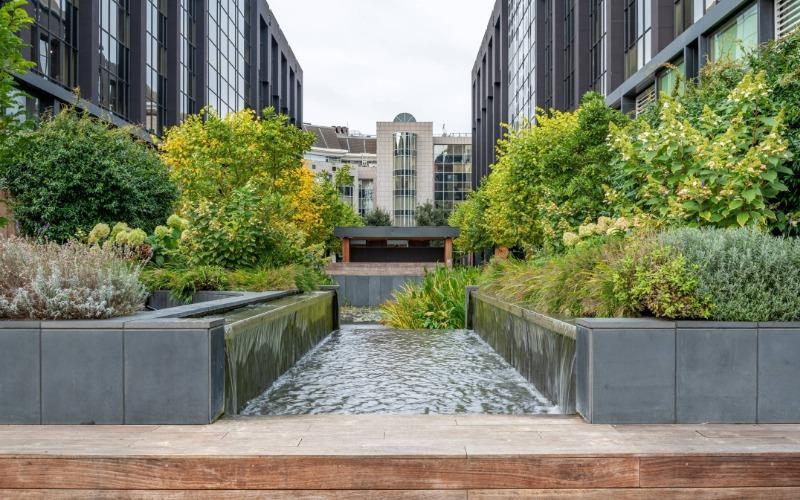
Do Commercial Water Features Need Draining? Why They Run All Year
The question of draining comes up most in autumn, when some sites switch their feature off and empty it out of habit. It happened last year, so it happens again, and the pool sits dry, or half full of leaves and rainwater, until someone books a restart in spring. This guide explains why a commercial feature is built to keep running, when draining is the right call, and what draining without a good reason costs you.
Commercial water features are built to run all year
Commercial water features are specified for permanent public settings: office plazas, public realm, hotel courtyards, heritage gardens. They are designed to be on show every day of the year, and the plant behind them is built and sized on that basis.
That includes the British winter. Three things keep a feature running safely through the colder months:
- Moving water. Water that circulates freezes far less readily than water standing still. A feature that keeps pumping is in a better position on a cold night than one switched off with water left in it. The exception is where ice on surfaces creates a hazard.
- A protected plant room. Pumps, filters and pipework sit in a plant room or chamber that is kept frost-free, so the equipment that matters most stays out of the cold.
- Controls set for the conditions. Circulation and water treatment are maintained, and display elements may need timer adjustments to stop before dusk so surfaces can dry. Climate sensors such as frost stats or wind anemometers come into play to reduce risk from water spray onto surfaces where it could create a hazard. aintain circulation and treatment, display elements may need timer adjustments to stop before dusk to allow surfaces to dry. Climate sensors such as frost stats or wind anemometers come into play to reduce risk from water spray onto surfaces where it could create a hazard.
None of this is unusual. It is how a commercial feature is meant to operate, and it is the basis of every maintenance programme Waterscapes runs.
The exception is a feature that was never built to commercial standards: a small decorative piece on a garden-grade pump, exposed pipework with no frost protection, or plant housed somewhere as cold as the outside air. These turn up most often on sites that have changed hands. If you have inherited a feature and don't know how it was specified, a condition survey will show whether it can run all year or needs changes first.
Drain for maintenance, not for the season
There are good reasons to drain a water feature. They all come down to work that needs doing on it:
- Repairs to a leaking pool, a failed joint or damaged pipework.
- Leak investigation, where the feature has to be emptied to find where the water is going.
- Deep cleaning that can't be done with the feature full.
- Resurfacing or waterproofing of the pool, rill or channel.
- Refurbishment of pumps, filtration, lighting or the feature itself.
That work can happen at any time of year. Winter often suits it, because a planned shutdown affects fewer people when fewer are using the space, but the timing follows the job rather than the calendar.
A maintenance drain-down is planned around the work. It has a start date, a scope and a date when the feature is refilled and running again. It is not left open-ended until spring.
If a feature keeps needing to come out of service for repairs, that is usually a sign the conversation should move from repair to refurbishment.
What draining without a reason costs you
Draining a feature when there is no work to do feels like the cautious option. In practice it tends to cost more than it saves, in three ways.
How the site looks
It changes how the site looks for months. An empty pool in a courtyard or entrance plaza is a poor sight, and an autumn drain-down leaves it that way from November to March, when the landscape has least else going for it. For a managed estate where presentation is part of the job, that matters.
Standing water
A drained feature rarely stays empty. Rain, leaves and windblown debris collect in the pool and in any low points of the pipework. Within a few weeks the feature holds a shallow layer of still, dirty water with nothing moving it and no treatment in it. Standing water is the condition every water hygiene plan tries to avoid (see our guide to Legionnaires' disease and unmaintained water features).
A bigger restart in spring
The restart becomes a bigger job. A feature that has kept running needs regular servicing. One that has been drained needs cleaning out, refilling, a reset of its water treatment and a full recommissioning of pumps, filtration and controls before anyone can rely on it again. That means more time on site, more cost, and more chance of finding a fault just as the busy season starts.
Keeping it running well
A feature that runs all year still needs looking after. The water quality, the plant room and the visible surfaces all need regular attention, and someone needs to own that.
Three things should be agreed with whoever maintains the feature:
- Who checks it, and how often. Whether that is an in-house team, a maintenance contractor or both, the visits should be booked, not assumed. The schedule can change with the seasons; the feature doesn't need to stop.
- What gets reported. Changes in water clarity, unusual noises from the plant room, ice forming at the edges in a cold snap, or a drop in water level all need passing on promptly.
- Who to call. A clear route to a specialist for anything outside the in-house team's remit.
For the cold months specifically, the full routine, from water testing to plant room checks to surface care, is set out in our guide to winter water feature maintenance.
Before anyone drains the feature
If someone on site suggests draining the feature, these questions will tell you whether it is the right move:
- Is there maintenance work that needs the feature empty? If not, there is rarely a reason to drain it.
- Is the work booked? A drain-down should start when the contractor is ready to begin, not weeks before.
- Who will look after it while it is drained? An empty feature still collects water and debris, and still needs inspecting.
- When will it be refilled, and by whom? A drain-down without a restart date tends to run until someone notices.
- What will the restart cost? Compare the recommissioning work after a long drain-down with the cost of keeping the feature on a maintenance programme.
"A feature that's running gets looked at. One that's been drained tends to be forgotten until March, and that's when the problems show up," says Ed Harwood, Maintenance Contracts Manager at Waterscapes. "If there's a repair to do, drain it, fix it and get it running again. If there isn't, leave it on and keep it maintained."
Book a maintenance visit
If you're responsible for a commercial water feature and aren't sure whether it is fit to keep running, Waterscapes can visit, check the feature and its plant, and tell you whether it can run all year or whether there is work that justifies a planned drain-down.
Waterscapes maintenance service covers planned visits all year round, water quality management, repairs and refurbishment, for features we installed and for those installed by others. Get in touch to book a visit.